Related articles

After Hannibal’s defeat, Carthage tried for some fifty years to live in peace with Rome
Sign up for our free weekly newsletter
Related articles
After Hannibal’s defeat, Carthage tried for some fifty years to live in peace with Rome
Sign up for our free weekly newsletter
Little
remains of the great North African empire that was Rome's most
formidable enemy, because, as Richard Miles explains, only its complete
annihilation could satisfy its younger rival.
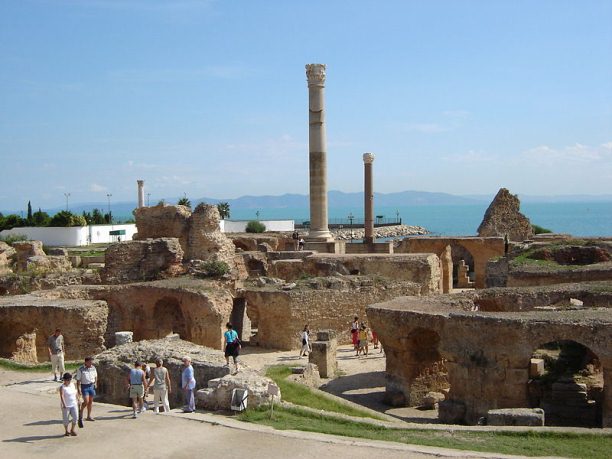 Thermes of Antoninus Pius, CarthageIn
the spring of 146 BC the North African city-state of Carthage finally
fell. After three years of embarrassing setbacks, the Roman army under
its new and relatively inexperienced commander, Scipio Aemilianus, had
managed to break through the Carthaginian defences and establish an
all-important bridgehead at Carthage’s circular war harbour, an
engineering masterpiece with capacity for at least 170 ships and ramps
to drag the craft to and from the water’s edge.
Thermes of Antoninus Pius, CarthageIn
the spring of 146 BC the North African city-state of Carthage finally
fell. After three years of embarrassing setbacks, the Roman army under
its new and relatively inexperienced commander, Scipio Aemilianus, had
managed to break through the Carthaginian defences and establish an
all-important bridgehead at Carthage’s circular war harbour, an
engineering masterpiece with capacity for at least 170 ships and ramps
to drag the craft to and from the water’s edge.The Roman forces were in a position to launch a final assault on the Byrsa, the citadel of Carthage and the religious and administrative heart of the city. The legionaries were, however, forced to fight every step of the way on the narrow streets that led up the hill as desperate defenders rained missiles down on them. Despite this stiff resistance, it was now a question of when rather than if Carthage would fall.
The Carthaginians who had sought refuge in the tall houses that flanked the city’s streets were flushed out by fire and the sword. The Greek historian Appian, whose writings are the main surviving source for this episode, wrote of how Scipio employed squads of soldiers to drag burnt and mutilated corpses off the streets so that the progress of his legionaries was impeded no further.
It still took six days and nights to break Carthaginian resolve, with Scipio deploying his forces in rotation to preserve both their strength and sanity for the ghastly work in which they were engaged. On the seventh day a party of Carthaginian elders bearing a peace offering of olive branches from the sacred Temple of Eshmoun, the Carthaginian god of healing, which sat on the highest point of the Byrsa citadel, came to the Roman general begging that their lives and those of their fellow citizens be spared. Scipio acceded to their request and later that day 50,000 men, women and children left the citadel through a narrow gate in the wall.
Although the vast majority of its surviving citizenry had surrendered, a rump consisting of Carthage’s commander-in-chief, Hasdrubal, his family and 900 Roman deserters – who could expect no mercy from Scipio – were still holed up in the precinct of the Temple of Eshmoun. Time, however, was on the side of the Romans and eventually this small group of diehards was forced up onto the roof of the building to make a final stand. It was then that Hasdrubal’s nerve finally broke. Deserting his wife and children, he went in secret to Scipio and surrendered. It would be left to his wife to deliver a fittingly defiant epitaph for the dying city by throwing herself and her children into the flames of the burning temple after venting scorn at her husband’s cowardice.
Although it is a myth that Scipio had the site of Carthage ploughed with salt to ensure that nothing would flourish there again, he was certainly keen to ensure that the city bore the full force of Roman opprobrium. As the fires burnt on the Byrsa Hill, Scipio ordered his troops to demolish the city’s walls and ramparts. Following military custom, the Roman general also allowed the soldiers to loot the city and rewards were handed out to those legionaries who had displayed conspicuous bravery during the campaign. Scipio then personally distributed all gold, silver and religious offerings, while other spoils were either sent to Rome or sold to raise funds. The surviving arms, siege engines and warships were burnt as offerings to the gods Mars and Minerva and the city’s wretched inhabitants sent to the slave markets, with the exception of a few grandees, including Hasdrubal, who, after being led through Rome as part of Scipio’s triumph, was allowed to lead a life of comfortable confinement in various Italian cities.
The brutal destruction of Carthage by the Romans has retained its power to both shock and provoke. When in the 1950s the poet and playwright Bertolt Brecht cast around for a historical metaphor to remind his fellow Germans about the dangers of remilitarisation, he instinctively turned to an event that had taken place over 2,000 years before:
Great Carthage drove three wars. After the first one it was still powerful. After the second one it was still inhabitable. After the third one it was no longer possible to find her.In recent years the ongoing crisis in Iraq has also afforded political commentators many opportunities to equate the situation in that unfortunate land with what befell Carthage. The following words by the American sociologist and historian Franz Schurmann are typical of the kind of emotive comparisons that have been drawn:
Two thousand years ago the Roman statesman Cato the Elder kept crying out, ‘Delenda est Carthago’ – Carthage must be destroyed! To Cato it was clear either Rome or Carthage but not both could dominate the western Mediterranean. Rome won and Carthage was levelled to the ground.Brecht and Schurmann use the example of Carthage to make seemingly conflicting points: one sees the fall of the city as the result of a hubristic desire for military might; the other views it as the supreme example of destructive bullying by a more powerful and ruthless rival. In fact, whether you view Carthage as villain or victim, those judgments are based almost exclusively on the historical testimony of Carthage’s greatest enemy, Rome.
Iraq is now Washington’s Carthage.
It was not just the physical fabric of Carthage that Scipio sought to obliterate. The learned tomes that graced the shelves of the city’s libraries, with the exception of the famous Carthaginian agricultural treatise by Mago which was spirited back to Rome, were dispersed among the local Numidian princes who had aided Rome in their war of extermination against Carthage. Nothing more starkly reflects the success of this Roman project than the fact that less than a couple of thousand words of Punic – the Carthaginian tongue – are known and many of these are proper names. The spoils of war not only included the ownership of Carthage’s territory, resources and people but also its past. Destruction did not mean total oblivion. A far worse fate awaited Carthage as a mute, misrepresented ghoul in the historical annals of its enemies.
Both Greek and Latin literature would consistently portray the Carthaginians as mendacious, greedy, untrustworthy, cruel, arrogant and irreligious. Particularly shocking to modern sensibilities are the lurid accounts of hundreds of children being sacrificed by immolation in order to placate Baal Hammon and Tanit, the bloodthirsty chief deities of Carthage. Such was the emphasis placed by the Romans on Carthaginian treachery that the Latin phrase Fides Punica, literally ‘Punic Faith’, became a popular ironic expression denoting gross faithlessness.
Carthage was, of course, not the only city to suffer destruction at the hands of Rome. In the very same year that Scipio’s troops were carrying out their grim work in North Africa, the venerable Greek city of Corinth was suffering a similarly traumatic fate at the hands of another Roman army. However, it is Carthage’s fate that history remembers. It was not the demolishing of the walls, the burning of the houses or the enslaving and killing of the population that made this episode so infamous but its completeness and the cold-blooded determination with which it was carried out.
Many explanations have been put forward as to why Rome invested so much in the destruction of Carthage. Hatred and vengeance certainly played their part. After all, the two states had fought two of the greatest and bloodiest wars – the Punic Wars – that the ancient world had known. Many Romans considered Carthage to have been their greatest enemy, the ‘whetstone’ of their greatness. Victory over Carthage in the First Punic War (264-241 BC) had demanded that the Romans, who had no previous naval experience, develop their own fleet and defeat the pre-eminent sea power of the ancient world in a period of a little over three decades. In that short time the Mediterranean had been transformed in the Roman mind from a dangerous unknown to Mare Nostrum, ‘our sea’. For many Romans the final defeat and destruction of Carthage was the great watershed moment of a glorious and eventful history because it marked the transformation of Rome from Italian to ‘world’ power.
Moreover, Carthage had taken Rome to the brink of total defeat. During the Second Punic War (218-201 BC), the great Carthaginian general Hannibal had blazed a trail of devastation across Italy, humiliating a series of Roman armies along the way. It had taken every ounce of Roman resilience and resources to eventually dislodge Hannibal from the Italian peninsula but not before he had come close to capturing Rome itself and, in all likelihood, final victory. Even a century later, the Roman poet Statius was still evoking the ghoulish spectre of ‘Libyan hordes’ marauding through the Italian countryside.
There was also the question of Rome’s ruthless application of realpolitik. By the time of the third and final Punic War (149-146 BC) Carthage, despite having made an impressive economic recovery from the disastrous depredations of its defeat in the Second Punic War, was a mere shadow of the power that it had once been. It was really no threat to Rome, which by that time controlled much of the Mediterranean. Despite this, a powerful clique within the Roman senate, led by Cato the Elder of Delenda est Carthago fame, had pushed hard for Carthage to be neutralised permanently. With the argument won, Carthage had been harassed into a foolhardy act of defiance that had at last given the Roman senate the justification to send its legions back to North Africa.
Yet, despite the contemporary emphasis on the destruction of Carthage being the result of the desire for a final settling of accounts, it is clear that more pragmatic considerations were at the fore of Roman thinking on this matter. The sacking of what was still one of the richest port cities in the ancient Mediterranean was unquestionably a hugely profitable business. The slave auctions and the seizure of a large swathe of previous Carthaginian territory, which now became public land owned by the Roman state, contributed to a massive infusion of wealth into both public and private Roman coffers. At the same time, the conspicuous destruction of such a famous city sent an unequivocal message: dissent from Rome would not be tolerated and past glories counted for nothing in this new world. The destruction of Carthage now stood as a bloody memorial to the cost of resistance to Rome and a suitably apocalyptic fanfare for Rome’s coming of age as a new world power.
In the face of such a litany of destruction and misrepresentation, both ancient and modern, one might legitimately ask whether it is really possible to write a history of Carthage that is anything more than just another extended essay on victimhood and vilification.
There are some intriguing but equally frustrating clues. Within the burnt-out structure of a temple (thought by its discoverer, the German archaeologist Friedrich Rakob, to have been the Temple of Apollo ransacked by Roman soldiers) were the remains of an archive thought to have contained wills and business contracts, stored there so that their integrity and safekeeping was guaranteed by the sacred authority of the god. The papyrus on which the document was written was rolled up and string wrapped around it before a piece of wet clay was placed on the string to stop the document from unravelling and a personal seal was imprinted upon it. However, in this particular case, the same set of circumstances that ensured the seals were wonderfully preserved because they were fired by the inferno which engulfed the city also meant that the precious documents that they enclosed were burnt to ashes.
Faced with such historical lacunae there is always a temptation to overcompensate when imagining what has actually been lost. However, we should be wary of assuming that the shelves of Carthage’s famous libraries groaned under the weight of a vast corpus of Punic and earlier Near Eastern knowledge now destroyed. Although rumours circulated in the ancient world of mysterious sacred parchments which had been hidden away before Carthage fell and there are scattered references in much later Roman literature of Punic histories, it is difficult to gauge whether the city was really a great literary centre comparable with Athens or Alexandria.
At times, researching a history of Carthage is rather like reading a transcript of a conversation in which one interlocutor’s contribution has been deleted. However, the responses of the existing protagonists, in this case Greek and Roman writers, allows one to follow the thread of the discussion. Indeed, it is the sheer range and scale of these ‘conversations’ that allows the historian of Carthage to recreate some of what has been expunged. Ideology and egotism dictate that even historians united in hostility towards their subject still manage vehemently to disagree with one another and it is within the contradictions and differences of opinion that existed between these writers that this heavily biased monologue can be partially overcome.
As regards other material evidence, the ruins of Carthage have always stirred the imagination of those who visited them. Rumours that the Carthaginians had managed to bury their riches in the hope of returning to retrieve them in better times had led the troops of one first-century BC Roman general to commence an impromptu treasure hunt. For the modern archaeologist Carthage can resemble a complicated jigsaw of which many pieces have been intentionally thrown away. Yet history tells us that such final solutions are rarely as comprehensive as their perpetrators would have us believe.
Although the religious centre on the Byrsa was completely demolished, many of the outlying districts and, as we have already seen, some parts of the hill itself escaped total destruction. In fact, the Romans inadvertently did much to preserve parts of Punic Carthage by dumping thousands of cubic metres of rubble and debris on top of it. Even the ominous two-foot-thick black tidemark found in the stratigraphy of the western slopes of the Byrsa, the archaeological record of the razing of the city in 146 BC, is packed full of southern Italian tableware, telling us what pottery styles were in vogue in Carthage at that time.
Then there are the thousands of monuments recording votive offerings made to Baal Hammon and Tanit, which, although extremely formulaic, have furnished invaluable information on Punic religious rites. This is especially so in the case of child sacrifice, which is revealed in a different light to the hysterical ritualised savagery found in the historical accounts. There is also a small number of surviving inscriptions relating to other aspects of city life, such as the construction of public monuments and the carrying out of an assortment of religious rituals. This epigraphic evidence has been helpful in aiding understanding not only of Carthage’s religious life but also the social hierarchies that existed within the city. It is from the writing on these slabs of stone that we learn of the faceless potters, metal smiths, cloth weavers, fullers, furniture makers, carters, butchers, stonemasons, jewellers, doctors, scribes, interpreters, cloak attendants, surveyors, priests, heralds, furnace workers and merchants that made up the population of the city.
The picture of Carthage that emerges from these very fragmentary glimpses is a strikingly different one from the barbarous, cruel and aggressive city-state found in the Greek and Roman historical canon. Carthage might have been founded by settlers from the Phoenician city of Tyre in what is now southern Lebanon, but it was older (early eighth century BC) than any Greek city in the central or western Mediterranean region; so much for its ill-founded reputation as oriental gatecrasher into a pristine Hellenic world. Its Phoenician name, Qart-Hadasht, or ‘New City’, suggests that Carthage was set up as a colonial settlement and not just as a trading post.
Strategically the site could not have been better chosen, for it stood on the nexus of the two most important trans-Mediterranean trading routes, the east-west route that brought silver from the mines of southern Spain to Tyre and its north-south Tyrrhenian counterpart that linked Greece, Italy, Sicily and North Africa.
It is now thought that Carthage might have actually been established to act as a larger civic centre for other smaller Phoenician colonies in the region. It certainly grew quickly. Although archaeologists are yet to locate any of the important public buildings or harbours from that early period, current evidence indicates that the littoral plain began to fill up with a densely packed network of dwellings made of sun-dried bricks laid out on streets with wells, gardens and squares, all situated on a fairly regular plan that ran parallel to the shoreline. By the early seventh century BC the settlement was surrounded by an impressive three-metre-wide casement wall. So swift was the development that in the first hundred years of the city’s existence there is evidence of some demolition and redevelopment within its neighbourhoods, including the careful re-location of an early cemetery to make way for metal workshops. Three further large cemeteries ringing the early city indicate that, within a century or so of its foundation, Carthage was home to around 30,000 people, a very considerable number for that period.
Although at first luxury goods were imported from the Levant, Egypt and other areas of the Near East, by the mid-seventh century BC Carthage had become a major manufacturer itself through the establishment of an industrial area just outside the city walls, with potter’s kilns and workshops for purple dye production and metalworking. Carthage now became a major manufacturer of terracotta figurines, masks, jewellery, delicately carved ivories and decorated ostrich eggs, which were then exported throughout the western Phoenician colonies.
The decline of Tyre as an economic and political force in the first decades of the sixth century BC led to Carthage assuming the leadership of the old Phoenician colonies in the central and western Mediterranean. This was hardly surprising because already Carthage was the most populous and economically powerful member of that grouping. The real source of Carthaginian might was and would remain its fleet, the greatest in the Mediterranean for hundreds of years. A huge mercantile fleet ensured that Carthage was the nexus of a vast trading network, transporting foodstuffs, wine, oil, metals and luxury goods, as well as other cargoes across the Mediterranean. If a couple of much later Greek and Roman sources are to be believed, then Carthaginian expeditions also made their way into the Atlantic, travelling as far afield as West Africa and Britanny.
With the most feared fleet in the Mediterranean, Carthage remained one of the pacesetters in naval technological innovation. In the fourth century BC it was the first to develop the quadrieme, which was both bigger and more powerful than the trireme, the ship that had dominated naval warfare for the previous 200 years. Marine archaeologists, who have studied the remains of several Carthaginian ships lying on the sea bed just off Marsala on the west coast of Sicily, were amazed to discover that each piece of the boat was carefully marked with a letter which ensured that the complex design could be easily and swiftly assembled. The Carthaginians had developed what was, in essence, a flat-pack warship.
With Carthaginian leadership of the western Phoenician colonies confirmed, we see the growing influence of recognisably Carthaginian cultural traits in other western Phoenician colonies. These included the adoption of Punic, the Levantine dialect spoken in Carthage, as well as a new taste for the luxury goods and religious practices favoured in the city.
Yet the headship of the Phoenician community in the west was not the only source of Carthage’s burgeoning power. For the first centuries of its existence the Carthaginians had been hampered by the very limited extent of their hinterland, which meant that they had been forced to import much of their food. This began to change in the sixth century BC as Carthage sometimes expanded aggressively into the territory of its Libyan neighbours. A whole raft of farmsteads and small towns was developed on this new land with the result that Carthage also became an agricultural powerhouse, producing food and wine not only for its own population but also for export. The Carthaginians were also celebrated for certain technological advances in agriculture, such as the tribulum plostellum Punicum, or Punic cart, a primitive but highly effective threshing machine.
Interestingly, this economic and political dominance did not translate into any imperial aspirations until the last decades before the First Punic War. However, the Carthaginian leadership of a Punic bloc that took in North Africa, Sardinia, western Sicily, southern Spain, the Balearics and Malta did become increasingly involved overseas, politically and militarily. The most significant of these ventures was on Sicily where heavy economic investment and the presence of strategically important Phoenician colonies meant that Carthage quickly became a major player in the highly volatile political landscape that existed there. Over the following two centuries Carthage was obliged to send a number of armies to Sicily in order to defend its own and its allies’ interests there, particularly from encroachments by the most powerful Greek city-state on the island, Syracuse. Military action between the two powers and their allies was punctuated by periods of ‘cold war’ in which each side eyed the other warily.
Despite some Sicilian-Greek historians’ claims to the contrary, this was never a straight conflict between the Punic and Greek blocs. Carthage, in particular, often co-operated with Sicilian Greek city-states worried about the growth in Syracusan power. More generally, Greek, Punic and indigenous communities on the island intermarried and worshipped each others’ gods and goddesses as well as trading and making war and political alliances with one another. Indeed, it was often the deep and long-standing relationships that existed between supposedly bitter rivals that were the driving force in the creation of a surprisingly cohesive and interconnected central and western Mediterranean.
Politically Carthage was certainly influenced by the Hellenic world, introducing constitutional structures that resembled but did not ape those found in the Greek city-states. Carthage had long been an oligarchy, dominated by a cartel of rich and powerful merchant families represented in a Council of Elders with one dominant clan usually holding the role of first amongst equals. However, over time this led to the introduction of more representative bodies and officials. A body called the Tribunal of One Hundred and Four, made up of members of the aristocratic elite, now oversaw the conduct of officials and military commanders as well as acting as a kind of higher constitutional court. At the head of the Carthaginian state were two annually elected senior executive officers, the Suffetes, as well as a whole range of more junior officials and special commissioners who oversaw different aspects of governmental business such as public works, tax-collecting and the administration of the state treasury. A popular assembly that included all members of the citizen body was also introduced. However, much to the approval of the Athenian political scientist Aristotle, its powers were strictly limited. In fact, Aristotle thought that the Carthaginian constitution of the fourth century BC was the best balanced in the Mediterranean world. Later, however, in line with many Greek states, the powers of the popular assembly increased markedly, leading to charges that Carthage was going down the road of demagogy.
One finds the same mixture of emulation and innovation in Carthage’s interactions with Greek culture. There is good evidence for members of the Carthaginian elite being educated in Greek, and Greek artistic and architectural traits were often adopted and adapted for Punic tastes. This familiarity with Greek art, rather than leading to mere mimicry, allowed the Punic population of the island to express itself in new and powerfully original ways. Traditional Phoenician art forms such as anthropoid sarcophagi, stone coffins whose human heads, arms and feet protruded out from a piece of smooth stone like human pupae, acquired Greek dress and hair decoration. And it was not just one-way traffic. Sicilian Greek art, and architecture in particular, was clearly influenced by the Punic world.
Perhaps the most striking example of Greco-Punic cultural interaction was found by archaeologists excavating on the site of the Punic city of Motya in Sicily in 1979. It was an oversized marble statue of a young man, standing 1.8 metres tall without his missing feet. Although the arms had also gone, it was relatively simple to reconstruct the pose of the left arm, as the hand has been carved resting on the hip. The head was framed by a fringe of curly hair and had once worn a crown or wreath kept in place by rivets. All in all, it appeared to conform to the severe Greek sculptural style of the early fifth century BC and, indeed, a very similar statue of an ephebe, a young man of military training age, has been discovered on the site of the Sicilian Greek city of Acragas.
It has been argued that only a Greek sculptor could have created such a high quality piece and that the Motya ephebe was a looted Greek work. However, there was a problem. Unlike other statues of ephebes from this period, who are depicted nude, the Motya young man is clothed in a fine long tunic with flowing pleats bounded by a high girdle. Many ingenious solutions have been proposed to explain this anomaly. The strange girdle and hand positions have led to the suggestion that the young man was either a Greek charioteer or a sponsor of a chariot race. However, the Motya figure is very different from other surviving statues of Greek charioteers. In fact, the closest parallels are found within the Punic world. First, despite the clearly Greek sculptural form, the statue follows the Punic convention of not displaying the nude body; second, the clothes and headgear worn by the young man bear a marked resemblance to the ritual garments worn by priests of the cult of the Punic god Melqart, with whom Heracles would enjoy an increasingly close association in Sicily. Neither Greek nor Punic but Sicilian, the Motya ephebe stood as a glittering testament to the cultural syncretism that was such a powerful force in this region.
In such a brief survey it is simply impossible to do justice to all of the different ways that Carthaginian political, economic and cultural dynamism helped to create a western Mediterranean world that existed long before Rome came on the scene. Carthage was, in reality, the bedrock on which much of Rome’s success as an imperial power was founded. Rome was not just the destroyer of Carthage but also the inheritor of a politically, economically and culturally joined-up world which was Carthage’s greatest achievement. The Romans were always ready, although sometimes grudgingly so, to recognise their debt to the Greeks. However, these had tended to be in cultural fields such as philosophy, art and history that the Romans did not wish, or did not have the confidence, to claim as their own. In fact the creation of what we know as the classical world was founded on the recognition of the complementary nature of Greek and Roman talents. Greek innovation met Roman dynamism. The existence of Carthage, a dynamic Mediterranean power which had also enjoyed a similar complementary relationship with the Greek world, was an inconvenient truth that Rome was simply not willing to acknowledge. Thus Carthage’s brutal end might have had as much to do with Roman insecurity about creating its own unique legacy as any desire for vengeance or plunder.
Related articles
After Hannibal’s defeat, Carthage tried for some fifty years to live in peace with Rome
Sign up for our free weekly newsletter
Related articles
After Hannibal’s defeat, Carthage tried for some fifty years to live in peace with Rome
Sign up for our free weekly newsletter

Sem comentários:
Enviar um comentário